
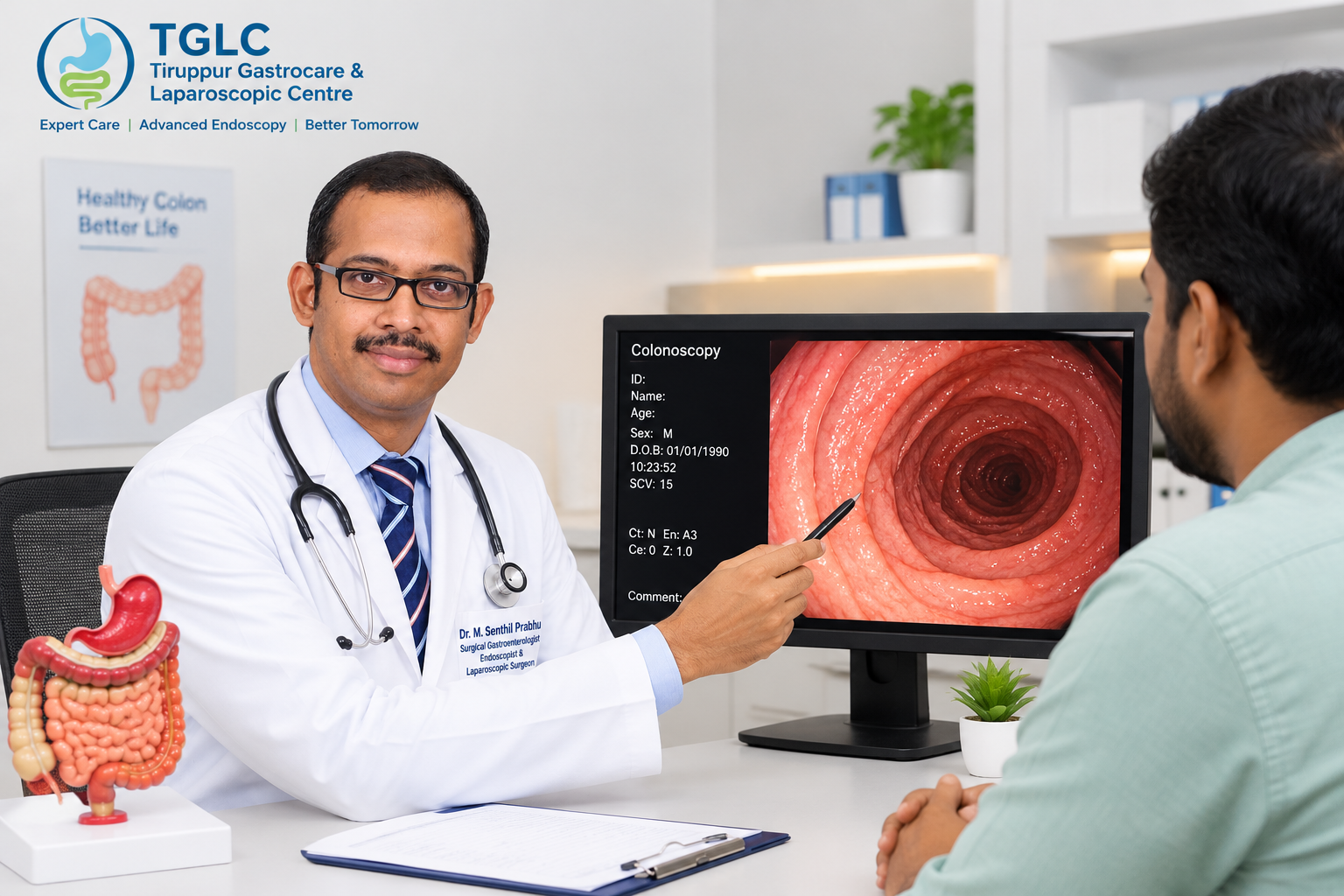
Colonoscopy in Tiruppur – Expert Colon Care at Tiruppur Gastrocare & Laparoscopic Centre
Persistent bowel problems? Blood in your stools? Unexplained abdominal pain? Don’t ignore the warning signs.
Your digestive health plays an important role in your overall well-being. If you are experiencing changes in bowel habits, rectal bleeding, long-term constipation or unexplained stomach pain, a colonoscopy may help identify the underlying cause.
At Tiruppur Gastrocare & Laparoscopic Centre (TGLC), we provide diagnostic colonoscopy services to help evaluate conditions affecting the colon and rectum. Under the care of Dr. M. Shenthil Prabhu, Surgical Gastroenterologist, Endoscopist and Laparoscopic Surgeon, patients can receive a professional evaluation and an appropriate treatment plan based on their individual needs.
If you are searching for colonoscopy in Tiruppur, our team is here to help you take the next step towards better digestive health.
Don’t wait for symptoms to become worse. Book a consultation today.
Call: 94426 50505
01. What Is a Colonoscopy?
A colonoscopy is a medical procedure that allows a doctor to examine the inside lining of the large intestine, also called the colon, and the rectum.
During a colonoscopy test, a thin, flexible tube with a small camera, called a colonoscope, is gently passed through the rectum to examine the bowel. The images help the doctor identify abnormalities such as inflammation, ulcers, bleeding, polyps and other changes in the bowel lining.
If necessary, the doctor may take a small tissue sample for laboratory examination or remove certain polyps during the procedure.
A colonoscopy is an important diagnostic tool for investigating digestive symptoms and assessing the risk of colorectal cancer when screening is appropriate.
02. When Do You Need a Colonoscopy?
Many people ignore digestive symptoms because they feel embarrassed, assume the problem is minor or hope it will disappear on its own. However, persistent or unexplained bowel symptoms deserve medical attention.
Your doctor may recommend a colonoscopy if you experience:
Blood in stools: Fresh blood or repeated rectal bleeding that needs investigation.
Persistent constipation: Difficulty passing stools or a significant change in your usual bowel habits.
Long-lasting diarrhoea: Frequent loose stools without a clear explanation.
Unexplained abdominal pain: Recurrent cramps, discomfort or pain in the abdomen.
Changes in bowel habits: A persistent change in stool frequency, consistency or pattern.
Unexplained weight loss: Weight loss accompanied by digestive symptoms.
Iron-deficiency anaemia: Anaemia that may be associated with bleeding in the digestive tract.
Suspected colon polyps: Growths that may require examination, removal or laboratory testing.
Inflammatory bowel disease: Assessment or monitoring of conditions such as ulcerative colitis or Crohn’s disease.
Colorectal cancer screening: Screening or surveillance when recommended according to your age, medical history and risk factors.
Not every symptom requires a colonoscopy. Your doctor will evaluate your symptoms, medical history and examination findings before recommending the appropriate test.
03. Why Is Colonoscopy Important?
A colonoscopy does more than investigate digestive discomfort. In suitable patients, it can help detect important bowel conditions before they become more serious.
1. Helps identify the cause of bowel symptoms
Colonoscopy allows direct examination of the colon and rectum, helping doctors investigate persistent bleeding, bowel changes and unexplained abdominal symptoms.
2. Helps detect colon polyps
Colon polyps are small growths on the inner lining of the large intestine. Most are not cancerous, but some types can develop into colorectal cancer over time. Detecting and removing suitable polyps can help reduce this risk.
3. Supports colorectal cancer detection
Colonoscopy can help identify suspicious changes in the bowel lining and obtain tissue samples when needed. Early assessment is especially important when warning symptoms or significant risk factors are present.
4. Helps diagnose inflammatory bowel conditions
The procedure can help doctors evaluate inflammation, ulcers and other changes associated with conditions such as ulcerative colitis and Crohn’s disease.
5. May allow treatment during the same procedure
When appropriate, certain polyps can be removed and tissue samples can be collected during colonoscopy. This may reduce the need for a separate procedure.
04. What Happens During a Colonoscopy Test?
If your doctor recommends a colonoscopy, understanding the process can help you feel more prepared.
Step 1: Consultation and assessment
The doctor reviews your symptoms, medical history and current medications. You can discuss your concerns, the reason for the test and the available options for comfort or sedation.
Step 2: Bowel preparation
Your colon must be sufficiently clean for the doctor to examine its lining clearly. You will receive specific instructions about dietary changes, bowel-cleansing medication and when to stop eating or drinking.
Following these instructions carefully is essential for a reliable examination.
Step 3: The colonoscopy procedure
You will be positioned appropriately for the examination. The doctor gently guides the colonoscope through the rectum and colon while viewing images on a monitor.
The procedure may involve sedation or other comfort measures, depending on your medical condition and the centre’s protocol. Some people experience temporary bloating or cramping.
Step 4: Examination and findings
The doctor examines the bowel lining for abnormalities. If necessary and appropriate, tissue samples may be taken or polyps may be removed.
Step 5: Recovery and further advice
After the procedure, you will be monitored until you are ready to leave. Your doctor will explain the findings, discuss any laboratory results that are pending and recommend further treatment or follow-up if needed.
TGLC - Tiruppur
Colonoscopy Treatment at Tiruppur
Frequently Asked Questions About Colonoscopy
1. What is a colonoscopy test used for?
A colonoscopy is used to examine the colon and rectum, investigate bowel symptoms, detect polyps, evaluate possible sources of bleeding and help screen for colorectal cancer when appropriate.
2. How long does a colonoscopy take?
The examination commonly takes around 30–60 minutes, although the duration can vary. Preparation, recovery and observation may require additional time at the centre.
3. Do I need to prepare before a colonoscopy?
Yes. Most patients need bowel-cleansing medication and specific dietary instructions before the procedure. Follow the preparation plan provided by your healthcare team.
4. Can colonoscopy detect colon cancer?
Yes. Colonoscopy can identify suspicious abnormalities and allow tissue samples to be taken for laboratory testing. It can also detect and remove certain precancerous polyps. Not every abnormality is cancer, and biopsy results may be needed for diagnosis.
5. Can a colonoscopy detect piles?
Colonoscopy examines the colon and rectum and may help investigate rectal bleeding. However, piles (haemorrhoids) are often assessed through a clinical examination and, when appropriate, an examination of the anal canal. Your doctor will determine which tests are needed.
6. Is colonoscopy recommended for constipation?
A colonoscopy is not necessary for every person with constipation. It may be recommended when constipation is persistent, accompanied by warning symptoms, associated with relevant risk factors or otherwise requires further investigation.
7. Is colonoscopy necessary if I have no symptoms?
Some people may benefit from colorectal cancer screening even when they feel well. Whether colonoscopy is appropriate depends on individual risk factors, age, medical history and the screening guidance followed by your doctor.
8. Can I eat normally after a colonoscopy?
Many patients can resume eating after recovery, sometimes starting with light food if advised. Your doctor may give different instructions if you have undergone treatment during the procedure.
9. Where can I consult for colonoscopy in Tiruppur?
You can contact Tiruppur Gastrocare & Laparoscopic Centre to arrange a consultation and discuss whether colonoscopy is appropriate for your symptoms.
Address: 154, Dharapuram Road, Near Usha Theater, Elango Layout, Pudhukkadu, Tiruppur, Tamil Nadu – 641604.
Phone: 94426 50505.
Take the First Step Towards Better Colon Health
Digestive symptoms should never be a source of shame or a reason to delay medical advice. Whether you are experiencing persistent bowel problems or have been advised to undergo a colonoscopy, understanding the cause is an important step towards appropriate treatment.
At Tiruppur Gastrocare & Laparoscopic Centre, you can consult an experienced surgical gastroenterologist to discuss your symptoms, understand your diagnostic options and plan the next steps for your care.
Looking for colonoscopy in Tiruppur? Contact TGLC today.
Call 94426 50505 to schedule your consultation.

Book Your Consultation Today
Don't ignore persistent digestive symptoms. ✔ Stomach Pain ✔ Acidity ✔ Bloating ✔ Constipation ✔ Blood in Stool ✔ Fatty Liver ✔ Gallstones ✔ Pancreatitis ✔ GERD 📞 Call: 94426 50505
Address
154, Dharapuram Road, Tiruppur
Call Us
94426 50505
94426 50505